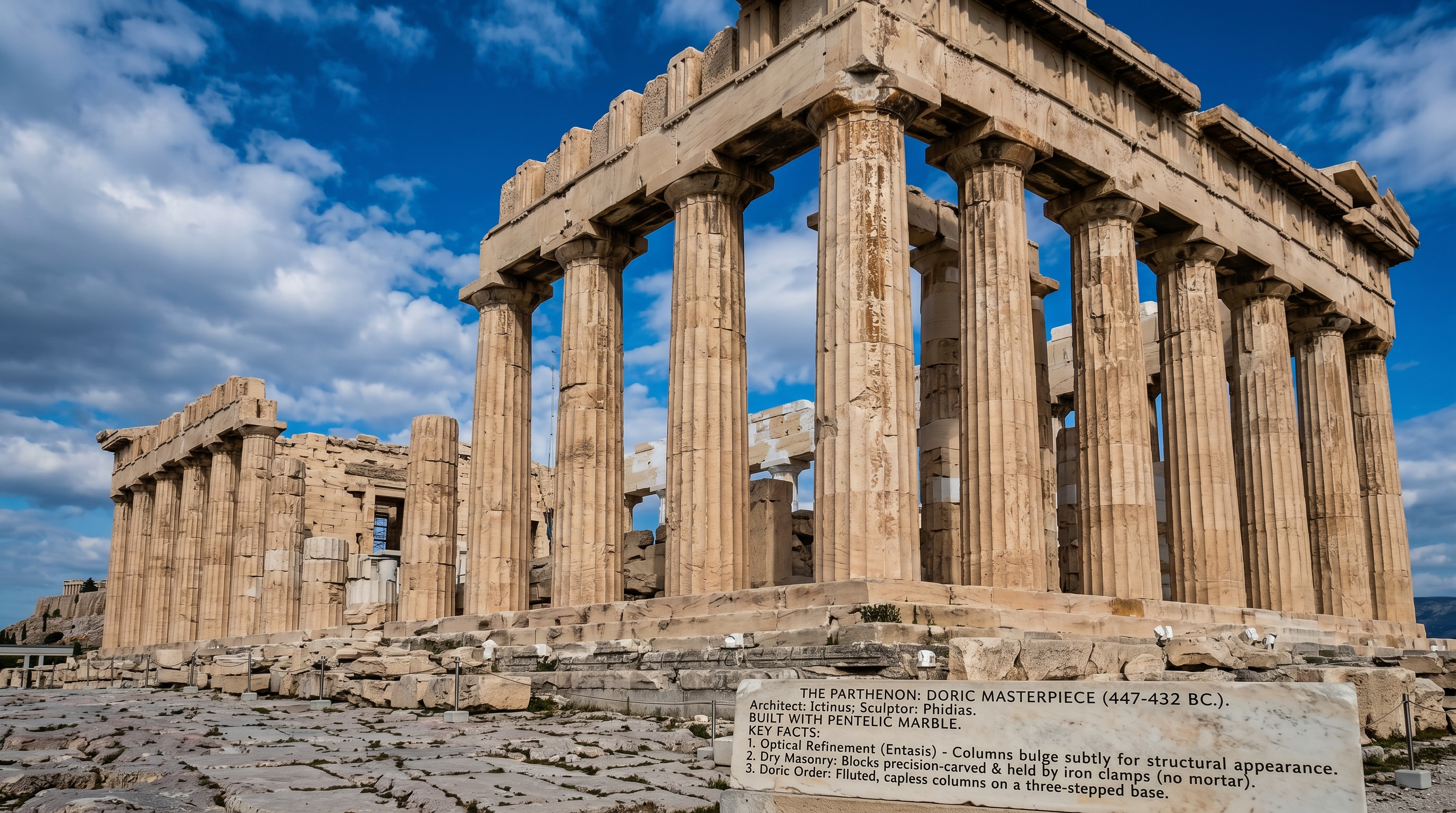
You have seen the photographs a thousand times. But standing in front of the Parthenon — knowing what it is, what happened to it, and what it took to build it — changes the experience completely. Here are 25 facts about the Parthenon that will make your visit to the Acropolis genuinely unforgettable.
Construction and History
1. The Parthenon was built between 447 and 432 BC. Construction took just 15 years — extraordinarily fast for a building of this scale and ambition. It was commissioned by the Athenian statesman Pericles as the crowning achievement of a building programme designed to showcase Athens’s power and wealth following the Persian Wars.
2. The architects were Ictinus and Callicrates. Two master architects worked together on the design. Ictinus is believed to have been responsible for the overall architectural concept, while Callicrates handled the more technical execution. Their collaboration produced one of the most precisely calculated buildings in history.
3. The sculptor Pheidias oversaw all the decorative work. Pheidias — the greatest sculptor of the ancient world — served as artistic director for the entire Acropolis building programme. He personally created the colossal statue of Athena inside the Parthenon and oversaw the teams of sculptors who carved the friezes and pediment groups.
4. The Parthenon replaced an earlier unfinished temple. An earlier temple on the same site — sometimes called the Pre-Parthenon — was destroyed by the Persians in 480 BC when they sacked Athens. Its column drums were deliberately incorporated into the north wall of the Acropolis as a visible reminder of Persian aggression.
5. It was built using Pentelic marble throughout. Every stone in the Parthenon — from the stylobate base to the column capitals to the roof tiles — is made of Pentelic marble from Mount Pentelikon, 16km northeast of Athens. An estimated 100,000 tons of marble were quarried and transported for the building.
Architecture and Engineering
6. The Parthenon is built in the Doric order. The exterior colonnade follows the Doric order — the oldest and most austere of the three classical Greek architectural orders. There are 8 columns on the short ends and 17 on the long sides, for a total of 46 outer columns.
7. The columns are not perfectly straight — by design. This is one of the most extraordinary facts about the Parthenon. The architects introduced deliberate optical corrections throughout the building to counteract the way the human eye perceives straight lines as slightly curved or sagging. The columns lean very slightly inward (if extended they would meet 1.5km above the building). The stylobate (base) curves slightly upward at the centre. The corner columns are slightly thicker than the others. Every element was adjusted to make the building look perfect — which means nothing in it is geometrically perfect.
8. The Parthenon combines Doric and Ionic elements. While the exterior is Doric, the interior featured a continuous Ionic frieze — 160 metres long — running around all four sides of the building’s inner chamber (cella). This frieze depicted the Panathenaic procession, the great festival held in honour of Athena every four years. Most of the surviving frieze sections are now in the British Museum (the Elgin Marbles) and the Acropolis Museum.
9. The building contains no mortar. The Parthenon was constructed entirely without mortar or concrete. Marble blocks were cut to extraordinary precision and fitted together using iron clamps and dowels set in lead. The precision of the joinery meant the structure’s strength came entirely from the weight and fit of the stone itself.
10. The Parthenon was originally painted in vivid colours. The marble is white today, but when the Parthenon was new it was painted in bright reds, blues, and golds. The carved details of the metopes, frieze, and pediment sculptures were all polychrome. Modern analysis using ultraviolet light has revealed the original colour schemes. The austere white marble aesthetic that has influenced Western architecture is a product of time and weathering, not the original intention.
The Statue of Athena Parthenos
11. A colossal gold-and-ivory statue of Athena stood inside. The Parthenon was built as a treasury and cult site for Athena Parthenos (Athena the Virgin). Inside the main chamber stood Pheidias’s chryselephantine (gold and ivory) statue of Athena — approximately 12 metres (40 feet) tall. The ivory represented her skin; the gold represented her robes, helmet, and shield. The gold alone weighed approximately 1,140 kg.
12. The statue no longer exists. The Athena Parthenos statue was removed from the Parthenon in late antiquity — possibly to Constantinople — and was lost or destroyed, probably by the 5th century AD. We know what it looked like only from ancient descriptions, coins, and small Roman copies. The best surviving copy is the Varvakeion Athena in the National Archaeological Museum in Athens.
13. The temple was dedicated to Athena Parthenos — the Virgin. The name Parthenon comes from the Greek word for virgin (parthenos). The building was essentially a great temple to Athena in her aspect as an unmarried warrior goddess — the divine protector of Athens. The Panathenaic Festival, held every four years with extraordinary ceremony, was dedicated to her.
Transformation Through History
14. The Parthenon served as a Christian church for nearly 1,000 years. When the Byzantine Empire Christianised Greece, the Parthenon was converted into a Christian church dedicated to the Virgin Mary (Theotokos Atheniotissa) — probably in the late 6th century AD. The conversion required significant modifications to the interior. The building served as a church throughout the Byzantine period, into the Latin occupation (1204-1458), and was known at one point as the Cathedral of Athens.
15. The Ottomans converted it into a mosque. After the Ottoman conquest of Athens in 1458, the Parthenon was converted into a mosque. A minaret was added — no longer standing — and the building underwent further modifications. It served as a mosque for over two centuries.
16. The 1687 explosion caused catastrophic damage. This is the most dramatic moment in the Parthenon’s post-ancient history. During the Venetian siege of Athens, a Venetian mortar round fired by the forces of Francesco Morosini struck the Parthenon on September 26, 1687. The Ottomans had been using the building as a gunpowder magazine. The explosion demolished the entire interior of the cella, blew out the central section of all four walls, and destroyed hundreds of columns and sculptures. The building has been a ruin ever since.
17. Lord Elgin removed sculptures between 1801 and 1812. Thomas Bruce, 7th Earl of Elgin, was the British Ambassador to the Ottoman Empire. Between 1801 and 1812, his agents removed approximately half of the surviving Parthenon sculptures — sections of the frieze, several metopes, and figures from both pediments. They were shipped to England and eventually sold to the British Museum, where they remain today. The Greek government has formally requested their return since 1983.
The Elgin Marbles and Ongoing Controversies
18. The Elgin Marbles debate remains unresolved. The Parthenon sculptures in the British Museum (officially called the Elgin Marbles, or more recently the Parthenon Marbles) represent one of the most prominent ongoing cultural property disputes in the world. Greece argues that the sculptures were removed illegally and should be reunited with the remaining sculptures in the Acropolis Museum in Athens. The British Museum maintains legal ownership. Negotiations continue without resolution.
19. The Acropolis Museum was built specifically to make the case for return. The Acropolis Museum, opened in 2009, was designed by architect Bernard Tschumi with the Parthenon Gallery on the top floor — a glass room that looks directly at the Acropolis hill and displays the surviving sculptures. The grey plaster casts placed between the originals represent the sculptures currently in London. The visual effect is deliberately powerful: the gaps are unmistakable.
Restoration and the Modern Parthenon
20. Restoration work has been ongoing since 1975. The Greek Ministry of Culture launched the Committee for the Conservation of the Acropolis Monuments in 1975. The ongoing restoration project — one of the longest-running and most complex in the world — has addressed structural damage, the effects of acid rain, and the damage done by early 20th-century restorations that used iron clamps (which rusted and cracked the marble). New titanium clamps are used in the current restoration.
21. Many fallen blocks are being put back in their original positions. Using photogrammetry, 3D scanning, and detailed archival records, the restoration team has identified thousands of marble fragments and is systematically re-erecting them in their original positions. Columns that fell in the 1687 explosion have been partially re-erected.
Records and Superlatives
22. The Parthenon is the most-photographed ancient monument in the world. There are no precise statistics, but by any estimate the Parthenon is among the most photographed ancient structures on earth. Over 3 million visitors climb the Acropolis annually, and the building appears on countless stamps, coins, and national symbols — including the official seal of the US state of Tennessee, which has a full-scale replica of the Parthenon in Centennial Park, Nashville.
23. It has inspired architecture on every inhabited continent. The Parthenon’s influence on Western architecture is immeasurable. The Lincoln Memorial in Washington DC, the British Museum in London, the Bolshoi Theatre in Moscow, the Scottish Parliament building — the list of buildings directly or indirectly inspired by the Parthenon’s proportions and aesthetic runs into the thousands.
24. The Parthenon stood largely intact for over 2,000 years. From its completion in 432 BC until the 1687 explosion — over 2,100 years — the Parthenon was never entirely destroyed. It survived conversion from temple to church to mosque, various earthquakes, and centuries of weathering. The explosion that ruined it came not from any ancient catastrophe but from early modern warfare.
25. Visiting the Parthenon in person is a different experience from any photograph. The scale, the quality of the light on Pentelic marble, the view of Athens in every direction, and the knowledge of what happened on this hill over 2,500 years — none of it translates to an image. If you are visiting Athens, the Acropolis is non-negotiable. Plan ahead, book your tickets or guided tour in advance, and go early in the morning or in the late afternoon when the crowds thin and the light is right.
Planning Your Visit
The Parthenon is on the Acropolis of Athens, accessible via the west entrance on Dionysiou Areopagitou Street. Entry costs EUR20 (April-October) or EUR10 (November-March) as a single ticket, or EUR30 as part of the combined archaeological sites ticket covering 7 sites.
Opening hours: Generally 8 am to sunset (hours vary by season — check the official Greek Ministry of Culture website for current times).
For the most rewarding visit, combine the Acropolis with the Acropolis Museum (EUR10, 400m from the entrance) where the original Parthenon sculptures are displayed. A guided tour significantly deepens the experience — the best Acropolis guided tours start from EUR35 and cover all the architectural and historical detail that on-site signage alone cannot convey.
Skip the queue at the Acropolis
Book skip-the-line tickets or a guided tour — instant confirmation, free cancellation.
See pricing & availability →Or compare all options on our Acropolis admission tickets guide.