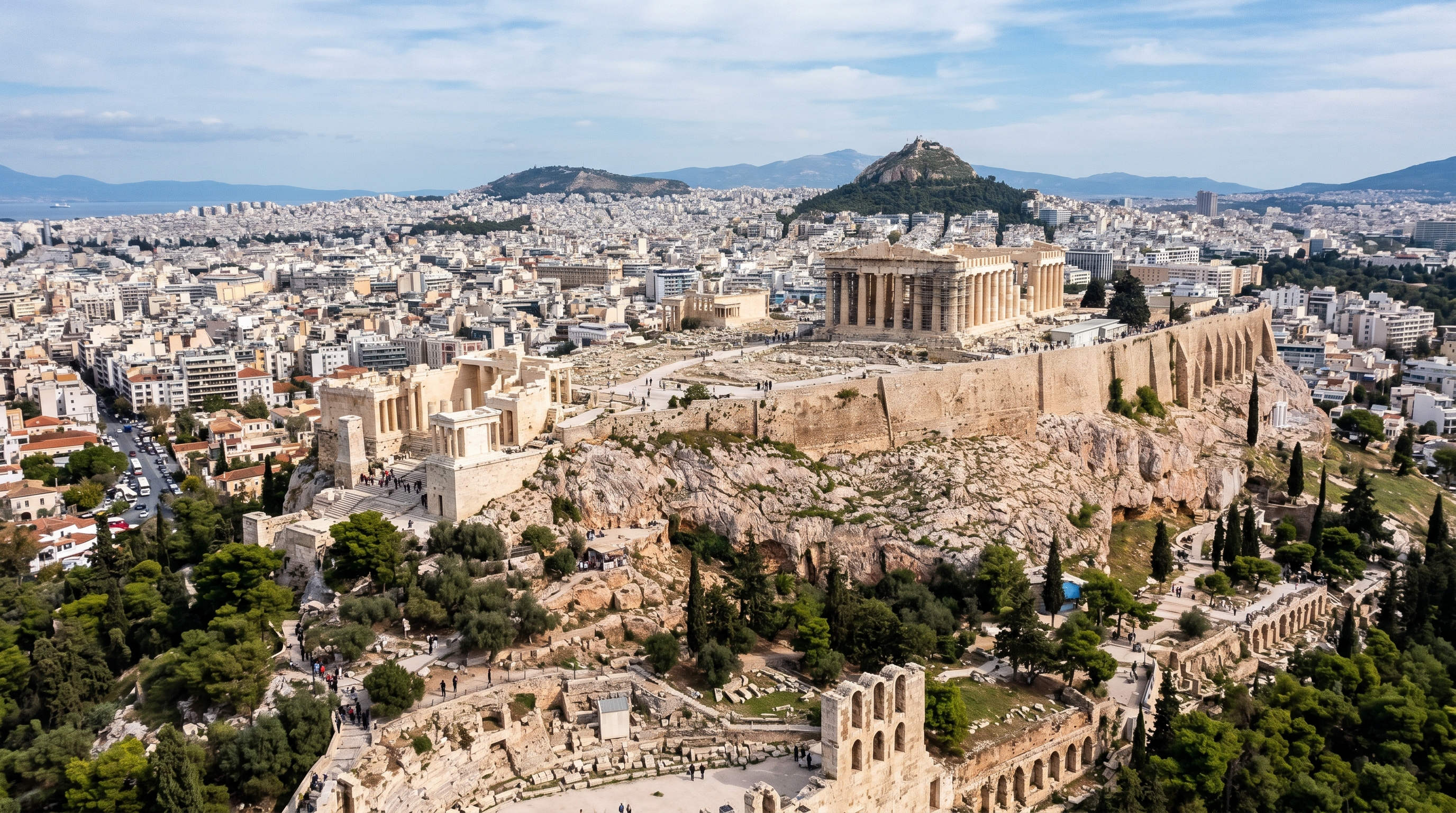
TL;DR: The Acropolis of Athens has been continuously occupied for over 3,000 years. It began as a Bronze Age citadel around 1400 BC and became the spiritual heart of ancient Greece during the 5th century BC under Pericles, when the Parthenon was built. It has since served as a church, a mosque, an ammunition dump, and today stands as a UNESCO World Heritage Site and the most visited monument in Greece.
The Acropolis is not just old. It is one of the most layered, fought-over, repurposed, and resilient places on Earth. Every culture that passed through Athens left its mark on this rock. Understanding that history makes a visit feel completely different. Instead of seeing ruins, you start to see the whole story.
This is the full history of the Acropolis, from its earliest foundations to the ongoing restoration work happening right now.
How Old Is the Acropolis?
The Acropolis has been inhabited since at least the 13th century BC, during the late Bronze Age. The word itself comes from the Greek “akron” (highest point) and “polis” (city). Nearly every ancient Greek city had its own acropolis, but Athens’ became so dominant that the name now refers to it alone.
The flat-topped limestone hill rises 156 metres above sea level and covers about 3 hectares. Its naturally defensible position made it the obvious choice for the earliest settlers of the Attica region, who used it as both a fortress and a religious sanctuary.
By around 1400 BC, the Mycenaean Greeks had built a substantial palace complex on the hill, surrounded by massive “Cyclopean” walls (so called because later Greeks believed only the mythological Cyclopes could have moved such large stones). Fragments of these walls are still visible today, incorporated into the base of the later Propylaea gateway.
The Acropolis in Greek Mythology
In Greek mythology, the Acropolis was the site of the legendary contest between Athena and Poseidon for patronage of the city. According to the myth, Poseidon struck the rock with his trident and produced a saltwater spring. Athena responded by planting an olive tree. The gods of Olympus judged Athena’s gift more useful, and she became the city’s patron. The city was named Athens in her honor.
This myth was not just a story. It was the foundation of Athenian civic identity. The Erechtheion, built on the north side of the Acropolis in the 5th century BC, was specifically designed to enclose the sacred spot where this contest was believed to have taken place. The olive tree planted in its courtyard was considered a direct descendant of Athena’s original tree.
The Archaic Period: Athens Takes Shape (700 to 480 BC)
During the Archaic period, Athens grew from a regional power into one of the most important city-states in Greece. The Acropolis evolved from a military citadel into a dedicated religious precinct. Earlier temples replaced the Mycenaean palace, and the hill became home to statues, offerings, and sacred objects.
The most significant building of this era was the Hekatompedon, an early temple to Athena built around 570 BC. Archaeological evidence suggests it occupied roughly the same footprint as the later Parthenon.
In 480 BC, the Persian army under Xerxes sacked Athens and burned the Acropolis to the ground. The Athenians had evacuated the city beforehand, but the destruction was total. The burned ruins of the old temples were buried beneath the surface of the hill, where they remained until archaeologists discovered them in the 19th century.
Surprisingly, this destruction led directly to the Acropolis’s greatest period. Athens rebuilt with confidence, ambition, and money from the silver mines at Laurion.
Pericles and the Golden Age: The Parthenon Is Built (447 to 406 BC)
The most important chapter in Acropolis history belongs to the statesman Pericles and the 5th century BC. This is when the monuments you see today were conceived and built.
The Parthenon (447 to 432 BC)
The Parthenon is the defining work of classical Greek architecture. Construction began in 447 BC under the direction of architects Iktinos and Kallikrates, overseen by the sculptor Pheidias, who also created the enormous chryselephantine (gold and ivory) statue of Athena housed inside.
The temple was dedicated to Athena Parthenos (Athena the Virgin). It measured 69.5 metres long and 30.9 metres wide. Its 46 outer Doric columns were built with subtle upward curves, called entasis, to correct for optical illusions that make perfectly straight columns appear to bow inward. This level of architectural precision remains extraordinary even by modern standards.
The Parthenon frieze, which ran around the entire inner wall, depicted the Panathenaic procession, a festival held every four years in Athena’s honor. About half of the surviving frieze panels are now in the British Museum in London, where they are known as the Elgin Marbles.
The Propylaea, Erechtheion, and Temple of Athena Nike
The same building program produced the Propylaea (the monumental gateway to the Acropolis, completed 432 BC), the Erechtheion (completed around 406 BC, housing the Athena Polias cult statue), and the small but exquisite Temple of Athena Nike, which still stands at the southwest corner of the hill.
Together, these four buildings created an architectural ensemble that has never been surpassed. Their influence on Western architecture from Rome to Washington DC is direct and traceable.
The Hellenistic and Roman Periods (323 BC to 267 AD)
After Alexander the Great died in 323 BC, Athens entered a long decline as a political power, even as it remained a major center of philosophy, art, and education.
The Romans held Athens in deep cultural esteem. The Emperor Hadrian visited twice and funded significant building projects in the city, including the Temple of Olympian Zeus (which you can visit with the combined Acropolis ticket). The Romans made offerings to Athena, added a small temple to Rome and Augustus on the east end of the Acropolis, and generally treated the site with reverence.
In 267 AD, the Herulians, a Germanic tribe, sacked Athens and damaged the Acropolis. This marked the beginning of a long period of decline.
The Byzantine Era: The Parthenon Becomes a Church (5th to 15th Century)
When Christianity became the official religion of the Roman Empire in the 4th century AD, the Parthenon’s fate changed dramatically. By the 6th century AD, it had been converted into a Christian church dedicated to the Virgin Mary (Theotokos, or “Mother of God”).
The conversion required significant alterations. The interior was rearranged to face east, a curved apse was added to the eastern end, and Christian imagery replaced or covered the original pagan decorations. The entrance was moved from east to west. Many of the original sculptural elements were removed or destroyed.
Despite these changes, the conversion also preserved the building. As a church, the Parthenon was maintained and used continuously for nearly a thousand years.
Ottoman Occupation and the 1687 Explosion
When the Ottoman Turks conquered Athens in 1458, the Acropolis once again changed hands and purpose. The Parthenon was converted into a mosque, and a minaret was added to one corner. The Erechtheion became a harem. The Propylaea served as the Ottoman commander’s residence.
The most catastrophic moment in the Acropolis’s post-ancient history came in 1687. During a war between the Ottoman Empire and the Republic of Venice, a Venetian fleet under Francesco Morosini besieged Athens. The Ottomans, knowing the Venetians were unlikely to bombard a building of such fame, stored their gunpowder inside the Parthenon.
They were wrong. On September 26, 1687, a Venetian mortar shell hit the Parthenon. The gunpowder exploded. The roof and most of the interior walls were destroyed. Three hundred people sheltering inside were killed. The building we see today, with its open roof and scattered drums, is the result of that single explosion.
Morosini attempted to take the large sculptural group from the west pediment as a trophy. His men dropped it while lowering it from the building, and it shattered.
The Elgin Marbles Controversy
Between 1801 and 1812, Thomas Bruce, the 7th Earl of Elgin, removed approximately half of the surviving sculptural decoration from the Parthenon, including sections of the frieze, metopes, and pediment sculptures. He transported them to Britain, where the British Museum purchased them in 1816.
The Greek government has sought the return of these sculptures for decades, arguing that they belong to a single, unified monument and should be reunited in Athens. The Acropolis Museum, opened in 2009, was built in part to make this case. Its Parthenon Gallery on the top floor displays the surviving Athens fragments alongside plaster casts of the London pieces, with deliberate empty spaces where the originals should be.
The British Museum has so far declined to return them. The debate continues.
Greek Independence, Restoration, and UNESCO Recognition
After Greece won independence from the Ottoman Empire in the 1820s, the Acropolis became a powerful symbol of the new nation’s ancient roots. The mosque and Ottoman additions were removed. Early archaeological work began, though some of it caused additional damage by using iron clamps that have since corroded and cracked the stone.
More systematic restoration began in the late 19th century and has continued in various phases ever since. In 1987, the Acropolis was inscribed as a UNESCO World Heritage Site, recognized as an outstanding example of classical Greek architecture and a monument of universal significance.
The current restoration program, run by the Acropolis Restoration Service (YSMA), has been ongoing since 1975. It uses titanium clamps instead of iron, returns displaced stones to their original positions where possible, and documents every element with laser scanning and photogrammetry. The work is expected to continue for decades.
The Acropolis Today
Today, the Acropolis receives millions of visitors every year. It is the most visited monument in Greece and one of the most recognizable landmarks on Earth. Ongoing restoration means you will always see some scaffolding or cranes during your visit, but this should be seen as a living commitment to preservation rather than a disappointment.
The story of the Acropolis is still being written. Come and see it in person.
Book a guided Acropolis tour now to experience 3,000 years of history with an expert guide who can bring every stone to life.
Frequently Asked Questions
How old is the Acropolis of Athens?
The Acropolis has been occupied since at least the 13th century BC, approximately 3,300 years ago. The Mycenaean Greeks built the first major structures on the hill around 1400 BC. The iconic buildings you see today, including the Parthenon, were built between 447 and 406 BC during the classical period.
Who built the Parthenon?
The Parthenon was built under the direction of the Athenian statesman Pericles. The architects were Iktinos and Kallikrates, and the renowned sculptor Pheidias oversaw the decorative program and created the colossal gold-and-ivory statue of Athena inside. Construction ran from 447 to 432 BC.
What happened to the Acropolis during the Ottoman period?
The Ottomans took control of Athens in 1458 and converted the Parthenon into a mosque. In 1687, during a siege by Venetian forces, gunpowder stored inside the Parthenon exploded after a mortar strike, destroying the roof and much of the interior. This is the primary cause of the ruined state we see today.
What are the Elgin Marbles?
The Elgin Marbles are sculptures removed from the Parthenon between 1801 and 1812 by the British diplomat Lord Elgin. They are now in the British Museum in London. Greece has requested their return for decades. The Acropolis Museum in Athens was built in part to support this case, with a dedicated Parthenon Gallery that displays surviving Athens fragments alongside casts of the London pieces.
When was the Acropolis designated a UNESCO World Heritage Site?
The Acropolis of Athens was inscribed as a UNESCO World Heritage Site in 1987. It was recognized as an outstanding example of classical Greek architecture and as a monument of universal cultural significance. Ongoing restoration work by the Acropolis Restoration Service continues today.
Skip the queue at the Acropolis
Book skip-the-line tickets or a guided tour — instant confirmation, free cancellation.
See pricing & availability →Or compare all options on our plan your Acropolis visit guide.