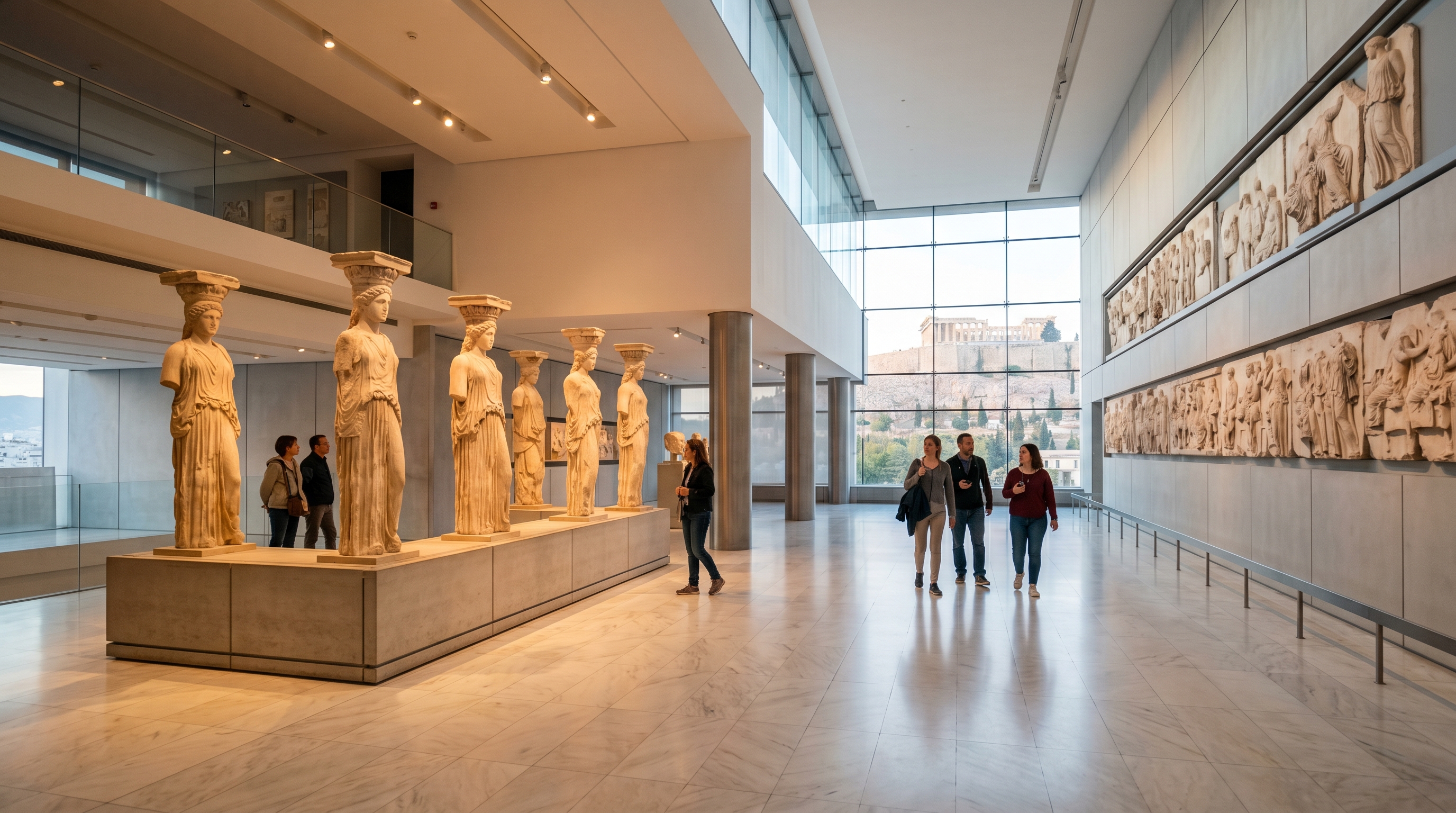
The Acropolis Museum is not just a support act for the hill above it. It is one of the finest museums in Europe — a building designed by a world-class architect to house sculpture of extraordinary quality, with a view of the Acropolis itself framed through every window. If you visit the Acropolis without also visiting the museum, you are leaving the best half of the experience behind.
This guide covers everything you need to know: ticket prices, opening hours, how to get there, a floor-by-floor breakdown of what to see, and the insider tips that make the difference between a rushed visit and a genuinely memorable one.
Why the Acropolis Museum Matters
When the Parthenon sculptures that remain in Athens were housed in the old Acropolis Museum (a small building on the hill itself), they were cramped, poorly lit, and almost impossible to appreciate. The new museum — opened in 2009 — was built to change that entirely.
Swiss-American architect Bernard Tschumi won the international design competition in 2001. His building is a triumph: a glass-and-concrete structure that floats above the ancient Athenian street below, with the Parthenon Gallery on the third floor oriented at exactly the same angle as the Parthenon on the hill and surrounded by floor-to-ceiling glass so that the building and the monument are in constant visual dialogue.
The museum also makes an unmistakable argument. The gaps in the Parthenon frieze — filled with grey plaster casts — represent the sculptures currently in the British Museum (the Elgin Marbles). Standing in the gallery, looking from the originals in Athens to the grey copies and back to the Parthenon through the glass, is one of the most affecting experiences in any museum anywhere.
Practical Information
Ticket price: EUR10 for adults. Reduced price (EUR5) for students and seniors (EU). Free for children under 18 and EU citizens under 25 with student ID. Note: the museum ticket is completely separate from the Acropolis site ticket (EUR20) — they are different institutions and you need to buy both.
Opening hours (2026):
- Monday: 9 am — 5 pm (last entry 4:30 pm)
- Tuesday — Thursday and Sunday: 9 am — 5 pm
- Friday: 9 am — 10 pm — the late Friday opening is the single best insider tip for visiting
- Saturday: 9 am — 8 pm
Hours extend in summer (April-October) — check the official Acropolis Museum website (theacropolismuseum.gr) for current seasonal hours before visiting.
Address: Dionysiou Areopagitou 15, Athens 117 42.
How to get there:
- On foot from the Acropolis: 400m, approximately 5 minutes south along Dionysiou Areopagitou pedestrian boulevard. Walk down from the Acropolis entrance, turn left, and the museum entrance is ahead on the right.
- Metro: Line 2 (red line), Acropolis station — the museum is directly adjacent to the metro exit. One stop from Syntagma (2 minutes), two stops from Monastiraki.
- Bus: Lines 230 and A2 stop near the museum.
- Taxi/rideshare: From Syntagma Square approximately EUR5-7.
Audio guide: Available for rent at the entrance for EUR5. Strongly recommended — the commentary adds significant depth, especially in the Parthenon Gallery where the relationship between the surviving originals and the absent sculptures is explained panel by panel.
Photography: Personal photography (without flash or tripod) is permitted throughout the museum. The Parthenon Gallery in particular rewards photography — the light is exceptional.
Floor-by-Floor Guide: What to See
Ground Floor — The Acropolis Slopes (Level 0)
The ground floor introduces you to the Acropolis before you even reach the exhibits. The entrance ramp passes over an archaeological excavation of an ancient Athenian street, visible through reinforced glass panels in the floor. You can see the foundations of houses, workshops, baths, and street surfaces dating from the Classical period through to early Christian times. This is a living piece of the ancient city, excavated when the museum’s foundations were dug in 2004.
The galleries on this level display finds from the slopes of the Acropolis — the area that surrounded the sacred hill and supported its function. These include:
- Votive offerings from the sanctuaries on the Acropolis slopes, including hundreds of small terracotta figurines
- Finds from the Sanctuary of Dionysus on the south slope (adjacent to the ancient Theatre of Dionysus)
- Relief sculptures from the Asclepeion (healing sanctuary) on the south slope
- An exceptional collection of pottery from the Acropolis sanctuary deposits
This floor is often passed through quickly by visitors eager to reach the statues upstairs — take 20-30 minutes here. The quality of the finds and the context they provide for the hill above repay attention.
First Floor — The Archaic Gallery (Level 1)
This is where the museum’s sculptural collection begins in earnest, and it is extraordinary. The Archaic Gallery covers the period approximately 700-480 BC — before the Parthenon was built — when a succession of earlier temples on the Acropolis were decorated with increasingly sophisticated sculpture.
Key works not to miss:
The Moschophoros (Calf-Bearer), c. 570 BC. A man carries a calf across his shoulders as a sacrificial offering — the smile on his face (the famous Archaic smile) is one of the most recognisable expressions in ancient art. This is one of the finest surviving examples of Archaic Greek sculpture in the world.
The Peplos Kore, c. 530 BC. A female votive statue (kore) originally painted — traces of the original red and blue paint on her peplos (robe) are still visible under certain lighting. The quality of the carving and the surviving polychromy make her exceptional even among the fine collection of korai (plural of kore) in this gallery.
The Kore of Antenor, c. 525-500 BC. At nearly 2 metres tall, one of the largest surviving korai — commanding and beautifully carved.
The Kritios Boy, c. 480 BC. A transitional work standing at the boundary of the Archaic and Classical periods. The Kritios Boy was the first Greek sculpture to stand in contrapposto — with the weight shifted to one leg, creating the naturalistic stance that would define classical and all subsequent Western sculpture. A pivotal moment in art history, in marble, in front of you.
The Blond Boy, c. 480 BC. A head fragment with traces of blond/yellow paint in the hair — used as evidence of the original polychromy of ancient Greek sculpture. Haunting in its preservation and in what it tells us about how these buildings and their sculptures originally appeared.
The first floor also houses the five surviving original Caryatids from the Erechtheion — the famous porch whose columns take the form of draped female figures. The sixth original is in the British Museum; a cast copy stands in its place in the Athens display. The five surviving figures are displayed in a climate-controlled case at close range. Seeing the Caryatids at eye level — the detail of the carved hair and drapery up close — is one of the outstanding experiences in all of Athens. When you later see the reproductions on the Erechtheion porch on the hill itself (the six figures there are all casts), you will understand what the originals look like.
Allow 45-60 minutes on the first floor minimum.
Second Floor — Temporary Exhibitions (Level 2)
The second floor hosts temporary exhibitions that change periodically. These have ranged from exhibitions on Acropolis restoration techniques to loans from international museums and thematic displays on specific periods of Greek history. Check the museum website for current programming. If nothing is running, this floor can be skipped.
Third Floor — The Parthenon Gallery (Level 3)
This is the reason the museum exists. The Parthenon Gallery occupies the entire top floor of the building — a long, glass-walled hall oriented at the same azimuth as the Parthenon itself. Through the glass on the north side, the Parthenon is directly visible on the hill 400m away.
The gallery displays the surviving Parthenon sculptures in their original sequence around the perimeter of the room — exactly as they would have appeared on the building. The arrangement is:
The Frieze (160 metres long): The continuous Ionic frieze that ran around the outer wall of the Parthenon’s inner chamber depicted the Panathenaic procession — the great festival honouring Athena held every four years. It shows horsemen, chariots, musicians, water-carriers, animals being led to sacrifice, and the culminating presentation of the sacred robe (peplos) to Athena. The surviving original sections from Athens are displayed in their correct positions. The sections currently in the British Museum are represented by grey plaster casts — significantly lighter in tone than the honey-coloured original marble — making the gaps unmistakably visible. Standing at the end of the gallery and looking down the full length of the frieze — originals interspersed with grey casts — is an experience unlike anything else in museum-going.
The Metopes: Square carved panels from the exterior Doric frieze, depicting mythological battles — Lapiths versus Centaurs (centauromachy), Gods versus Giants (gigantomachy), Greeks versus Amazons (amazonomachy), and scenes from the Trojan War. Several of the finest surviving metopes are displayed here.
The Pediment Sculptures: The triangular pediments at each end of the Parthenon contained large-scale sculptural groups. The east pediment depicted the birth of Athena from the head of Zeus; the west pediment showed the contest between Athena and Poseidon for patronage of the city. Many of the pediment figures are massive — the reclining god from the east pediment (possibly Dionysus or Heracles) is particularly striking in its relaxed, naturalistic pose.
Allow 45-60 minutes in the Parthenon Gallery. The audio guide is particularly valuable here.
Insider Tips
Go on a Friday evening. The museum is open until 10 pm on Fridays. After 7 pm, the crowds drop significantly, the Parthenon is floodlit through the gallery windows, and the experience is genuinely magical. This is the single best time to visit.
Visit before the Acropolis hill, not after. Seeing the sculptures in context at the museum before you climb the hill makes the monuments themselves much more legible. You will know what the metopes are, how the frieze fits together, and what the caryatid porch looks like at close range before you see the building itself.
Rent the audio guide (EUR5). The museum’s on-wall interpretation is good but the audio guide is excellent, particularly in the Parthenon Gallery where it walks you through the frieze narrative sequence by sequence.
Book a guided combo tour. Many Acropolis and Museum combo tours include both the Acropolis hill and the museum in a single guided morning. Seeing both with a qualified guide who can explain the relationships between the sculptures and their original positions on the building is transformative.
The museum restaurant (ground floor/mezzanine) has a terrace with Acropolis views. If you want to eat lunch or dinner with the Parthenon as your backdrop, this is one of the better-value options in the neighbourhood.
Allow at least 2 hours. A rushed visit in 60-90 minutes hits the highlights but misses the depth. Two hours allows you to spend proper time on the first floor Archaic Gallery and the third floor Parthenon Gallery without feeling pressed.
Frequently Asked Questions
Is the Acropolis Museum ticket included in the EUR30 combo ticket? No. The Acropolis Museum (EUR10) is a separate institution and is not covered by the EUR30 combined archaeological sites ticket. You pay for both independently.
What floor is the Parthenon Gallery on? The third floor (Level 3) — the top floor of the building, with 360-degree glass walls and a direct view of the Acropolis.
How long should I spend in the Acropolis Museum? 2 hours is the comfortable minimum for covering the main highlights: ground floor (20 minutes), first floor Archaic Gallery (45-60 minutes), and Parthenon Gallery (45-60 minutes). If you are deeply interested in ancient Greek sculpture, 3 hours is not excessive.
Is the Acropolis Museum accessible for visitors with mobility limitations? Yes. The building has lifts to all floors, ramps throughout, and step-free access from the entrance. It is one of the most accessible major museums in Athens.
Can I visit the Acropolis Museum without visiting the Acropolis hill? Absolutely — and it is a valid choice, particularly for visitors with mobility limitations who cannot manage the hill, or those visiting in very hot summer conditions. The museum stands completely on its own as a world-class experience.
Where do I buy tickets? At the museum entrance, or online at theacropolismuseum.gr. You can also book a guided Acropolis and Museum combo tour that includes entry to both.
Skip the queue at the Acropolis
Book skip-the-line tickets or a guided tour — instant confirmation, free cancellation.
See pricing & availability →Or compare all options on our Acropolis online tickets guide.