Best Free Things to Do Near the Acropolis Athens (2026)
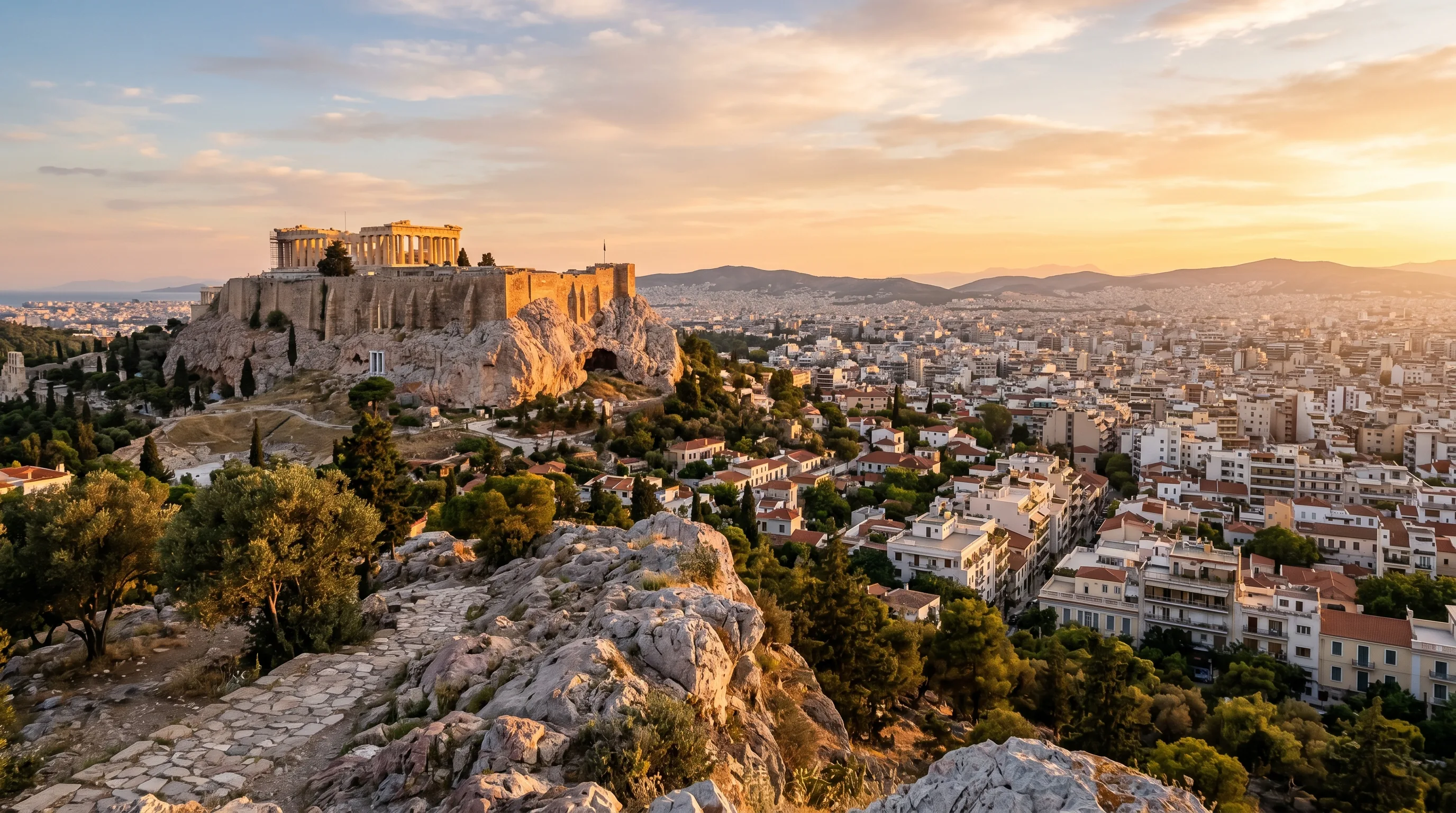
Athens is one of Europe's most rewarding cities for budget travellers. Within walking distance of the Acropolis you will find ancient ruins, panoramic viewpoints, vibrant squares, and centuries-old neighbourhoods -- all completely free. Here are the ten best free things to do near the Acropolis, ranked by visitor experience.
Filopappou Hill
The best free panoramic view of the Acropolis in all of Athens.
Located directly southwest of the Acropolis, Filopappou Hill (also called the Hill of the Muses) rises to 147m and offers the classic elevated photograph of the Parthenon. The paved path to the summit takes about 15-20 minutes at a gentle pace. The Filopappou Monument -- a Roman-era funerary monument to Syrian prince Philopappos -- sits at the top. The hill is always open and free. Go at golden hour (roughly 1 hour before sunset) for the best light. The pine-shaded paths are popular with joggers in the morning. Wear comfortable shoes as the stone surfaces can be slippery.
Areopagus Hill (Mars Hill)
Where the Apostle Paul preached in 51 AD -- and the view rivals any paid attraction.
The Areopagus is a bare limestone outcrop immediately northwest of the Acropolis entrance, about a 3-minute walk from the Propylaea gate. In antiquity it was Athens's highest court; a bronze plaque marks the spot where Paul delivered his famous sermon to the Athenians. The rock is steep and can be slippery -- use the carved steps and handrail on the left side. There is no fence, no ticket, and no opening hours. The view across the Ancient Agora and toward the city is outstanding. Arrive early morning to avoid the crowds that pour off tour buses from around 9 am.
Plaka Neighbourhood Walk
Athens's oldest inhabited neighbourhood is a free, living open-air museum.
Plaka spreads across the northern and eastern slopes of the Acropolis and retains its 19th-century neoclassical character better than anywhere else in central Athens. Wander the narrow lanes, admire the bougainvillea-draped houses, and explore the small squares. Key streets include Adrianou, Kydathinaion, and the picturesque Anafiotika micro-neighbourhood -- built by island craftsmen from Anafi who came to Athens in the 1830s and recreated a Cycladic village on the hillside. It is always open. Come in the evening when the restaurants light up but the souvenir shops close -- the neighbourhood regains its calm and character.
Hadrian's Arch
A triumphal Roman gateway that once marked the boundary between ancient and Roman Athens.
Hadrian's Arch (Hadrian's Gate) stands on Vasilissis Amalias Avenue at the edge of Plaka, about 700m east of the Acropolis entrance. Built by the Athenians to honour Emperor Hadrian around 132 AD, the arch is 18m tall and made entirely of Pentelic marble. The inscription on the side facing the Acropolis reads 'This is Athens, the ancient city of Theseus'; the other side reads 'This is the city of Hadrian, not of Theseus.' You can walk right up to it and through it at any hour -- there is no enclosure. It is one of the best free photo stops on any Acropolis visit.
Roman Agora Exterior
Caesar and Augustus funded this ancient market -- and you can see the main gate for free.
The Roman Agora is 500m northwest of the Acropolis. The interior requires a ticket (included in the EUR30 combo ticket), but the exterior -- particularly the Gate of Athena Archegetis, a grand 1st-century BC propylon with four Doric columns -- is fully visible from the street at no cost. The Tower of the Winds (Horologion of Andronikos Kyrrhestes), an octagonal marble clocktower and weather vane dating to around 50 BC, is also partially visible from outside. Stand on Pelopida Street for the best free view of the gate. An early-morning visit before the crowds arrive means near-empty streets and clear sightlines.
Monastiraki Square
Athens's most energetic free square -- flea market, Byzantine mosque, metro archaeology and non-stop people watching.
Monastiraki Square sits about 700m north of the Acropolis and is accessible by Metro (Line 1 or 3, Monastiraki station). The square itself is free and open 24 hours. Key free sights here: the Tzisdarakis Mosque (exterior), the Hadrian's Library ruins visible through the fence on Areos Street, and the Sunday flea market that spreads across the surrounding streets. The metro station itself has a glass-walled archaeological display showing finds from the excavation. The square is a great meeting point and a perfect spot to orientate yourself before heading to the Acropolis.
Psirri Street Art
The gritty, creative neighbourhood next to Monastiraki is Athens's open-air street art gallery.
Psirri is the district immediately west of Monastiraki, historically a working-class craftsmen's quarter and now a nightlife and arts hub. Its walls are covered in large-scale murals by both Greek and international street artists -- quality and scale rival Berlin or Lisbon. The best concentration is along Sarri Street, Ag. Anargyron Street, and the surrounding alleyways. It is always accessible and always free. Daytime offers the best light for photography. Combine with a coffee stop at one of the neighbourhood's independent cafes -- prices are noticeably lower than the tourist-heavy streets around Plaka.
Changing of the Guard at Syntagma Square
Athens's most theatrical free spectacle -- Evzone soldiers in full ceremonial uniform, every hour.
The Tomb of the Unknown Soldier in front of the Hellenic Parliament on Syntagma Square is guarded 24 hours a day by the Evzones -- the Greek presidential guard -- in their distinctive foustanella kilt uniform and pom-pom shoes. The full ceremonial Changing of the Guard takes place every hour on the hour, daily. The grand Sunday parade with the full regimental band happens at 11 am and draws the largest crowds. Syntagma is about 1.5km northeast of the Acropolis -- an easy 20-minute walk through the city centre. Arrive 5 minutes early to get a clear viewing position.
Athens First Cemetery
An unexpected free highlight -- neoclassical sculpture at museum quality, total peace.
The Athens First Cemetery (Proto Nekrotafeio) is located about 1.5km southeast of the Acropolis near the Panathenaic Stadium. It is the resting place of many of modern Greece's most significant figures -- politicians, writers, architects, and benefactors -- and is lined with extraordinary 19th and early 20th-century marble sculpture. The most famous work is Sleeping Girl (Koimomeni) by Giannoulis Chalepas (1878), considered one of the masterpieces of modern Greek sculpture. The cemetery is open daily, generally 7:30 am to sunset, and is entirely free. It is peaceful, shaded by cypress trees, and almost always quiet.
Kerameikos Ruins Exterior
Athens's ancient cemetery district -- remarkable ruins visible from the street at no cost.
Kerameikos, the ancient potters' quarter and cemetery of Athens, is about 1km northwest of the Acropolis. The archaeological site requires a ticket (included in the EUR30 combo pass), but significant sections of the ancient walls, the Sacred Gate, and the Dipylon Gate are visible from Ermou Street and the surrounding paths at no charge. The Eridanos river -- one of the few ancient Athenian rivers still partially visible -- runs along the site boundary. If you are not buying the combo ticket, the exterior view is still worthwhile and takes less than 15 minutes as a walk-by.
Book top Acropolis experiences
Guided tours, skip-the-line tickets, and Athens activities — free cancellation.
Browse all experiences →