Acropolis vs Sagrada Familia: Ancient Athens or Barcelona's Masterpiece?
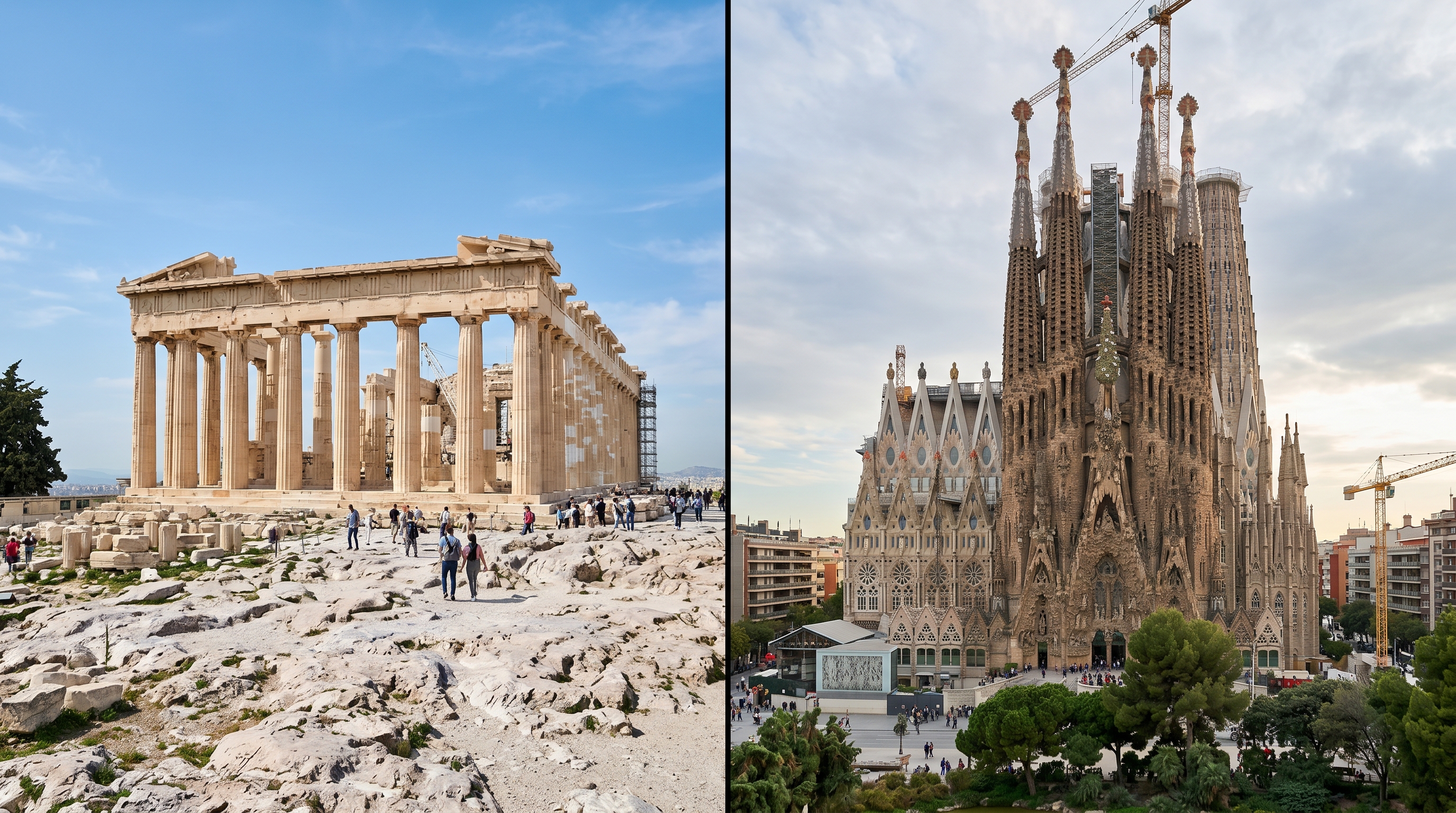
Both are iconic. Here is how they compare so you can decide -- or plan to do both.
Category: History and Age
Acropolis: 2,500 years old. Sagrada Familia: started 1882, still unfinished.
The comparison in age is almost comical but fascinating. The Parthenon was completed in 438BC and has stood for nearly 2,500 years. The Sagrada Familia was begun by Antoni Gaudi in 1882 and is projected to be completed in the 2030s -- making it a living construction project. Both are extraordinary but they represent entirely different relationships with time. The Acropolis is the endpoint of a civilisation; the Sagrada Familia is still becoming.
Category: What You See
Acropolis: ancient marble ruins in open air. Sagrada Familia: a living modernist cathedral of overwhelming interior colour and geometry.
The Acropolis is an outdoor archaeological site -- marble columns, ancient pathways, and views over Athens. The Sagrada Familia is primarily an interior experience -- the nave is flooded with kaleidoscopic light filtered through Gaudi's coloured glass, and the organic stone columns branch overhead like a forest. Both are visually overwhelming in completely different ways. Neither can be described adequately in words.
Category: Ticket Price
Acropolis: EUR20. Sagrada Familia: EUR26 to EUR35 depending on inclusions.
The Acropolis standard adult ticket is EUR20 peak season. The Sagrada Familia base ticket is EUR26, rising to EUR35 with tower access (strongly recommended -- the views from the Nativity and Passion towers over Barcelona are spectacular). The Sagrada Familia experience is more expensive but the building and its associated museum and towers offer more varied content per visit.
Category: Entry and Crowds
Sagrada Familia: strictly timed entry with limited capacity. Acropolis: timed slots but more open-air space.
The Sagrada Familia manages entry very tightly -- timed tickets must be booked well in advance (often weeks ahead in peak season) and the interior experience is controlled. The Acropolis has timed entry slots too but is an open-air site with more space to spread out. Both get extremely crowded in summer. The Sagrada Familia's enclosed interior makes peak-hour crowds feel more intense.
Category: Architectural Significance
Both are among the most studied buildings in the world -- for opposite reasons.
The Parthenon is the defining example of Classical Doric architecture and has influenced Western building for 2,500 years. The Sagrada Familia is the defining example of Catalan Modernisme and Gaudi's organic architecture -- its structural system of branching columns and parabolic arches is unlike anything in architectural history. Architecture students and enthusiasts find both transformative.
Category: City Experience
Athens for ancient world immersion. Barcelona for contemporary culture plus Gaudi.
Athens centres on its ancient heritage with the Acropolis as the focal point; the city is compact and the historic core walkable. Barcelona is a modern, vibrant city with outstanding food, design culture, beaches, and multiple Gaudi sites beyond the Sagrada Familia (Park Guell, Casa Batllo, Casa Mila). Both cities deserve 3 to 4 days minimum.
Category: The Verdict
Our recommendation -- these are incomparable. Choose based on what you are drawn to, not on a ranking.
Comparing the Acropolis and the Sagrada Familia is like comparing a symphony and a jazz improvisation -- both are masterpieces but of entirely different types from entirely different eras. If your passion is ancient history, the birthplace of democracy, and the roots of Western civilisation, choose Athens and the Acropolis. If you are drawn to visionary architecture, living creation, and a deeply modern sensibility rooted in spiritual ambition, choose Barcelona and the Sagrada Familia. If at all possible, do both -- they make each other richer.
Book top Acropolis experiences
Guided tours, skip-the-line tickets, and Athens activities — free cancellation.
Browse all experiences →